Biomechanics of the Locomotive System
GENERAL CONCEPTS
Mechanics
Branch of Physics that studies the state of rest or motion of bodies under the action of forces. Dedicated to study the motion of bodies, good in itself (describing it), good referring to its causes (the forces) and the lack of movement (equilibrium) in relation to theddd forces that cause it.
Sports Biomechanics
The objective of which is the optimization of sports technique, injury prevention and design of sports elements according to biomechanical criteria.
Biomechanics is usually divided in the same way
- Statics: Study of the forces that determine that bodies remain in equilibrium. Example: how a climber stays on some dams or how the windsurfer stays on the board.
- Dynamics: Study the movement or the lack of it related to the causes that cause it.
- Kinetics: Study of the forces that cause movement. Examples would have the study of the forces involved in that shot to the basket or during the exit of a sprinter.
- Kinematics: Part of Biomechanics that studies movements without having taking into account the causes that produce it, it is dedicated exclusively to its description. Describes the sports techniques or the different skills and routes that the man can do. Study examples could be a shot for a field goal or basketball or the distance covered by the point guard in a game.
JOINT KINEMATICS
Center of Gravity
It is the center of mass symmetry; It is the point where the mass of the body and the intersection of the 3 planes are concentrated: sagittal, frontal and horizontal. In a man it is about 60% of the height, in anatomical position, and varies when we make a movement from that position. The center of gravity in man, in anatomical position, falls between 2 feet, in the anterior part of these, that’s why the body tends to go forward, and to that the body does not fall, the gastrocnemius and spinal muscles contract isometrically, for this reason these muscles are called “antigravity”.
Base of Support
It is the force that circumscribes the parts of the body in contact with the support surface, that is, it is determined by the surface of support for.
Equilibrium
A body is in equilibrium when the projection of its center of gravity falls within the base of support, conversely when the CG falls outside of it the body loses its balance.
FACTORS AFFECTING BALANCE
- The base of support: The larger the base of support, greater will be the balance of any body
- The performance: The lower an object is, the lower its CG will be and the higher balance will have
- Weight: The heavier a body is, the more stable it is
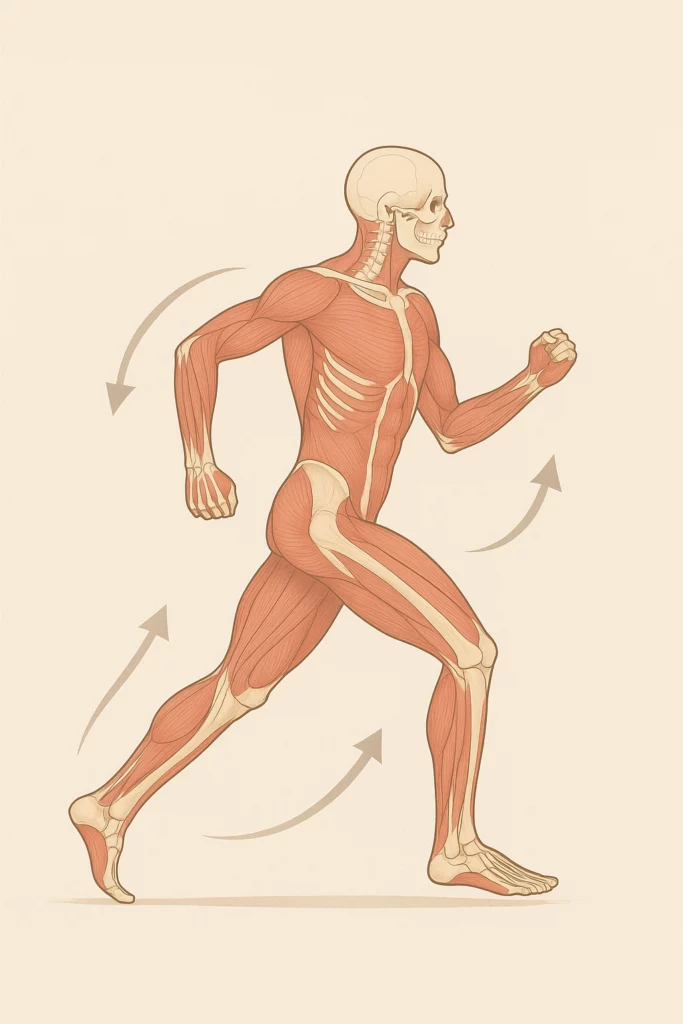
KINEMATICS OF THE LOCOMOTIVE SYSTEM
Just as a car transforms the chemical energy of gasoline into mechanical energy and therefore in motion, the human body also transforms the chemical energy of food in motion, this is the function of the musculoskeletal system which can be studied as a machine and its elements as mechanical elements.
Anatomical Elements and Mechanical Elements
- Bones – Levers
- Joints – Joints
- Muscles – Motor
- Tendons – Cables
- Ligaments – Reinforcements and Closures
Bones
They act like levers. It is the simplest machine, a rigid bar, with a point of support and two forces acting on it.
Joints
They serve as a point of union between the bone pieces and allow movement between them, acting as hinges.
Ligaments
Their cytological and histological structure is similar to the tendons, they are located between two contiguous bones preventing them from separating and allowing at the same time the movement of the joint. They act as security closures do in machines, reinforcements and security closures.
LEVERS IN THE LOCOMOTIVE SYSTEM
The lever is a simple machine, made up of a rigid bar that moves on a support point or Fulcrum, on which two forces intervene, one resistant or Resistance and other motor or Power.
For the study of lever systems in the musculoskeletal system, it is necessary to identify the anatomical elements that form part of the lever
- Fixed point or gear, known as FULCRO
- Motor of the gesture to be studied, that is, the muscle that causes the movement – POWER
- Element that opposes movement – RESISTANCE
The system is in equilibrium if
P × Bp = R × Br
F = Fulcrum / support point
R = Resistance to overcome
P = Power, force that must be generated to overcome resistance
Br = Resistance arm, distance from Fulcrum to Resistance application point
Bp = Power Arm, distance from Fulcrum to point of resistance application
Mechanical Analysis
A. If the fulcrum is at the same distance from P and R the two arms are equal and the magnitude of the forces will be equal
B. As the Bp is greater than the smaller Br will be the force that we have to apply to beat the Endurance – mechanical advantage
C. The smaller the arm of Power with respect to Resistance, the greater must be the magnitude of the Power to overcome Resistance – mechanical disadvantage
TYPES OF LEVERS
First Genre
The Fulcrum is between the Resistance and the Power
Example: Neck Extension
F = support point of the head (atlas and axis joint)
R = weight of the head located at its center of gravity
P = extensor muscles of the body, insertion on the nape
Second Genre
The Fulcrum is at one end and the Resistance between it and the Power
Example: Foot Plantar Extension
F = point of support of the foot on the ground
R = tibial-fibular-talar joint, center of gravity where all the weight of the body is located
P = ankle extensor muscles located at the point of insertion of the Achilles tendon on the calcaneus
Third Genre
The Power is applied at a point between the Fulcrum (at one end) and the Resistance. Therefore the Resistance Arm is always greater than the Power
Example: Elbow Flexion
F = elbow joint
R = weight of the forearm and objects that we hold
P = flexor muscles of the elbow, insertion of the ulna of the biceps brachii
Br (resistance arm) always greater than Bp (power arm). By applying power you can get the load to move quickly
APPLICATION OF BIOMECHANICS TO THE LOCOMOTIVE SYSTEM
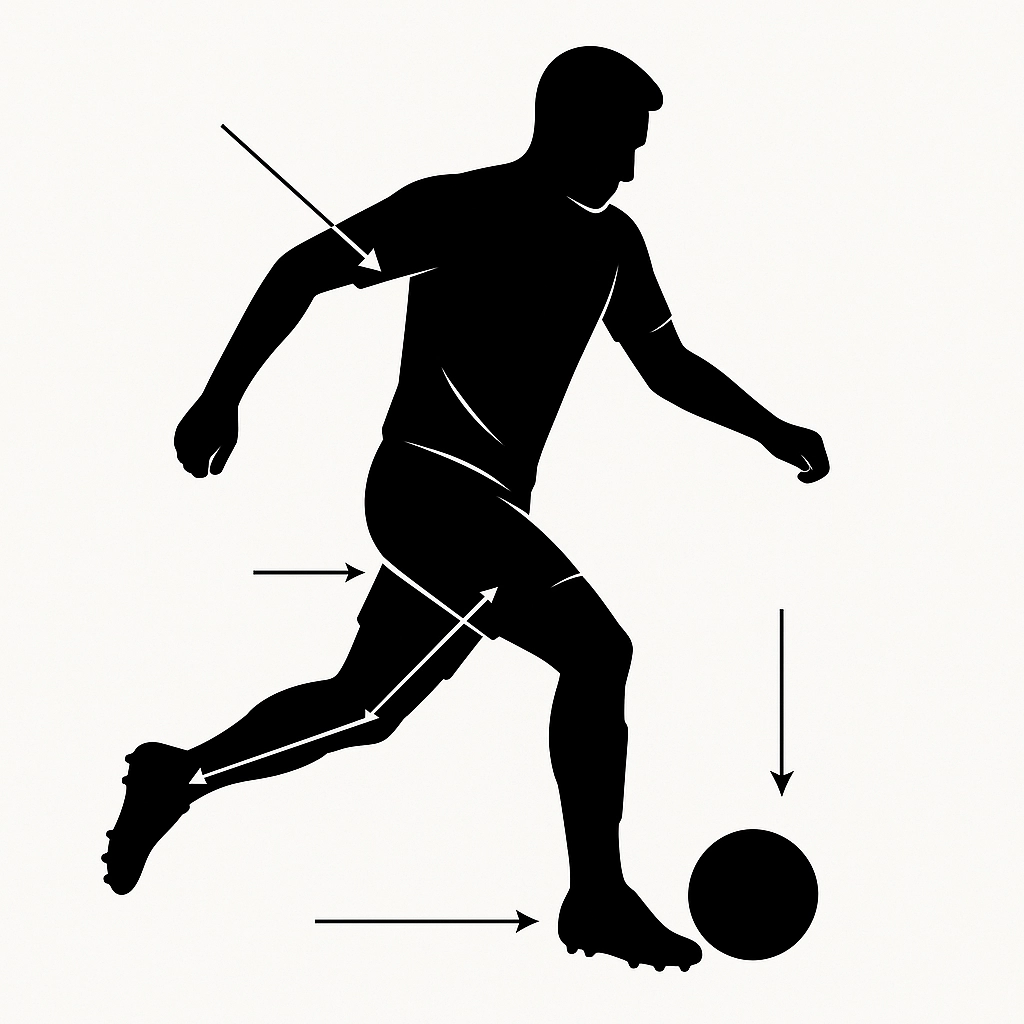
- To provide diagnostic tools in performance evaluation (basic skills and movements) in football
- To provide diagnostic tools in the evaluation of injuries associated with soccer activities
- To provide recommendations about training, teaching, and training methods for performance enhancement
- To make recommendations about factors related to performance and safety (relationships between players, movement and environment)
- To make recommendations for the prevention of injuries in soccer and to evaluate the therapeutic methods used in the treatment of injuries
HIGH-LEVEL SKILLS IN FOOTBALL
Generally and practically speaking, the content of the skills could be defined as the product of four different biomechanical elements, as follows:
Dexterity = Strength × Speed × Accuracy × Purpose
In general, force is the sum of various forces produced by internal forces (muscular force) and external forces (reaction forces, impact forces, air resistance, etc.)
In the human body, the speed of distal body parts (feet, hands, head) is produced through a system of levers in the joints. The linear velocity of the distal body parts depends on the length and the angular velocity of the respective levers (calf, thigh, etc.). The relative angular velocities for each part of the body will occur through the respective muscle group (knee extensors, dorsi flexors, etc.). Precision means a certain space that can be dependent on time due to the movement of the players on the field.
Purpose
Means the final product of an execution relevant to the situation of the game
Most of the actions and maneuvers in the different game situations are executed with submaximal force and speed but with high precision and with a purpose. Few maneuvers are executed with force and maximum speeds. The most successful actions in the game are observed when the purpose of an action is unique and the precision, speed and use of force are maximum.
BIOMECHANICAL PRINCIPLES BY OBJECTIVE
Precision Production – Principle
- Stable base of support
- Stable body support
- Active use of the distal segments (foot, tibia, trunk)
- Consistency in movement pattern (pass, pitch)
- Large ball contact area, if possible
Speed Production – Principle
- Successive generation of each velocity link from a proximal one to a lateral one
- Small initial radii at each link in the chain
- All participating muscles begin contraction at maximal length including concentric and eccentric muscle contractions
Power Production – Principle
- Successive use of body segments from the beginning of the movement through the action phase
- The whole of the muscular forces is transferred from the large muscle groups to the small muscle groups throughout the action phase
- Stable base of support, wide and low
- Application of general forces in the proper direction
Download this lesson as a PDF so you can study offline.